Showing posts with label book review. Show all posts

Tuesday, June 25, 2024

"The World Until Yesterday" by Jared Diamond

This book is not as Enlightening as Jared Diamond's other books.  Still, it is interesting because you get to read personal stories of Jared Diamond's years in Papau New Guinea.  As always,  the interesting and thing worth noting is that our present state of society is has only existed for the past 5000-10000 years.  The norms that we have accepted as norms are not really "norms" in that sense.


Saturday, August 06, 2022

Digital Minimalism Summary

The Controversial:

  1. As more people are failing to cultivate the high quality leisure lives that Aristotle identifies as crucial for human happiness, they leave a void that would be near unbearable if confronted but can be ignored with the help of digital noise. Erecting barriers against the existential  is not new - before YouTube, we had mindless Tv and heavy drinking to help avoid deeper questions. If you begin decluttering Low value distractions from your life before you convincingly filled in the void they were helping you to avoid, the experience will be unnecessarily unpleasant.  The most successful digital minimalist cultivate high quality leisure before culling the worst of their digital habits. A phenomenon will happen where digital habits they they previously felt to be essential to their daily schedule  suddenly seem frivolous.

What it is saying is that before i go and cut Facebook, Wechat etc out of my life through some apps control or deleting them on my phone,  I need to to find activities to fill up the void/space that they leave behind.  At least before August 2022, I did not agree with this point of view.   One reason may be that I did not think that I did not want to fill up my schedule completely.

However, now I am coming around to that.  This is because now with a job,  I don’t really have to struggle with You tube or Wechat that much.  That is also  surprising on its own because I recall how I use to clock in 3 hours on weekends just watch Youtube just as a form of escapism.  That said, I lost the focus on my physical training because work is just so all encompassing and draining. “Flow” also stated how people found themselves most at flow during work with challenges and targets. Maybe, that is why a job is also good.

I just need to find a job that only sucks me for 6 hours or half a day, or I need to put that one/ two pursuits above my job - which many people may already be doing.


Amazing Lines:


  1. Aristotle proposed an idea that has persisted throughout the intervening Millenia and continues to resonate with the understanding of human nature today: A life well lived requires activities that serve no other purpose than the satisfaction that the activity itself generates.As the MIT philosopher Kieran Setiya expands in his modern interpretation of “Ethics”: if your life consists only of actions whose “worth depends on the existence of problems, difficulties, needs, which these activities aim to solve”,  you are vulnerable to the existential despair that blooms in response to the inevitable question: “Is this all to life ?” One solution to this despair , he notes, is to follow Aristotle’s lead and embrace pursuits that provide you “a source of Inward joy”.
  2. “Only thoughts reached by walking have value” Nietzsche
  3. Doing nothing is overrated. In a busy modern life, it is tempting to crave the release of having nothing to do - whole blocks of time with no schedule, no expectations, no activities beyond whatever happens to catch your attention at the moment. These decompressions have their place, but the rewards are muted, as they tend to devolve towards Low quality activities like mindless phone swiping and half hearted binge watching .  Investing  energy into something hard but worthwhile almost always return much richer rewards.
  4. Walden: “The cost of a thing is the amount of what I will call life which is required to be exchanged for it, immediately or in the long run.
  5. Walking: fantastic source of solitude. Our technical definition of solitude as freedom from input from other minds. Solitude deprivation problem : a state in which you spend close to zero time alone with your own thoughts and free from inputs from other minds.
  6. Minimalists don’t mind missing out on small things; what worries them much more is diminishing the large things they already know for sure make a good life good.
  7. The culminate cost of non crucial things we clutter our lives with, can far outweigh the small benefits each individual piece of clutter promises

Mediocre Lines:

  1. It’s easy to be seduced by small amounts of profit offered by the latest app, but then forget its cost in terms of the most important resource we possess: minutes of our life.
  2. The more you use social media, the less time you tend to devote towards offline interaction.
  3. Sherry Turkle : Connection - the Low bandwidth  interactions that define our online social lives.  Conversations -  high bandwidth that defines real- world encounters between humans. Anything that is textual or non- interactive - all social media, text and email - doesn’t count as Conversation but only Connection.
  4. Rogowski: “As our species  evolved, we did so as beings that experience and manipulate the world around us.  When you use craft to leave the virtual world of screen and instead work in more complex ways with the physical world around you, you are living truer to your primal potential.”
  5. Arnold Benett: ”What? You say full energy given to those 16 hours will lesson the value of the business 8? Not so. On the contrary, it will assuredly increase the value of the business 8. One of the chief things which my typical man has to learn is that the mental faculties are capable of a continuous hard activity; they do not tire like an arm or a leg. All they want is change - not rest, except in sleep”.
    • I cannot agree with that . The only thing I can appreciate is that after a long day of mental, I need to use my hands instead.
  6. Digital technology should be subordinated to a support role: helping to set up your leisure, but not acting as the main source of leisure itself
  7. The premise Cal Newport suggests is to cultivate a high quality leisure life first, from there, it will be easier to minimise Low quality digital diversions later.
  8.  If you are interested in commentary on political and cultural issues, experience is enhanced by seeking out the alternative view .

How to go digitally at a minimal:

  1. The minimalist technology screen: to allow an optional technology into your life after the end of a digital declutter, it must: a) serve something you deeply value, be the best way to use technology to serve this value (if not , replace with something better), c) have a role in your life that is constrained with a standard operating procedure that specifies when and how you can use it.

Practices in each chapter that we can put into use:

Leisure lessons:

  1. Prioritise demanding activities over passive consumption
  2. Use skills to produce valuable things in the physical world
  3. Seek activities that require real- world , structured social interactions.
  4. Walking: fantastic source of solitude- our technical definition of solitude as freedom from input from other minds.
  5. if You begin decluttering Low value distractions from your life before you convincingly filled in the void they were helping you to avoid, the experience will be unnecessarily unpleasant.

“Spend time alone” Practices :
  1. Leave your phone at home
  2. Take long walks

“Don’t click like” practices :
  1. Don’t click “like”, don’t comment on social media.
  2. Write letters to yourself
  3.  Consolidate texting.  - answer backlogged messages in a single stretch.
  4. Hold conversation office hours - 5pm every work day?

“Reclaim leisure” practices:
  1. Prioritise demanding activity over passive consumption
  2. Use skills to produce valuable things in the physical world
  3. Seek activities that require real world ,structured interactions.
  4. Fix , build something every weekend
  5. Schedule your Low quality leisure time just like in O levels where you are allowed to watch TV 7-8pm everyday.
  6. Join something like an association like Benjamin Franklin
  7. Develop a leisure plan

“Join the attention resistance “ practices:
  1. Delete social media from your phone
  2. Turn your devices into single use device.  Such that any website /app that profits from your attention is blocked by default , and made available to you on an intentional schedule.

Thursday, March 17, 2022

Grant by Ron Chernow


Before I read this book, the story I knew of Grant was one when Lincoln was to me about the drinking habits of Grant and hence why Grant should be fired.  Lincoln supposedly replied “ find out what he drinks, and give it to the rest of my generals, he fights!”

In this book, I learnt that “if Lincoln freed the black man, Grant made him a citizen”. That was the major contribution of grant, sending federal troops to the South to protect the blacks in voting process, effectively ending the Ku Klux clan until their resurgence much later in the 1960s.

This is a bloody thick book: I remember reading nearly 3 hours of it in a sitting on my ebook , and still wondering the next few days when I was reading it, why am I not done yet ?   When I laid my hands on the physical book, did I learn that it was hell of a thick book.

It was great to learn more about other colourful characters like Sherman and his March through Georgia, Sheridan and his leadership to raise the men from the dead.


Some highlights:
1. However great Lee was as a tactician, Grant surpassed him in strategy. It was like 刘邦vs 项羽。
2. Military leadership: need for supreme audacity, vital importance of speed and element of surprise.
3. Grant had to take on General Harris. As Grant dreaded the approach, he found that Harris had absconded in response to Grant’s approach. “ Harris had been as afraid of me, as I had of him”. Henceforth, Grant would project himself into his enemies minds, and comprehend their fears and anxieties.
4. At Shiloh, Grant was stunned by combative spirits of his foes, he knew this would be a long grinding war of attrition, beginning his belief that this would be total warfare where all of southern society has to be defeated.
5. Frederick Douglas”once a black man has a musket on his shoulders and bullets in his pocket, no powers of earth can deny him that he has earned the citizenship of United States.
6. When brought with a major expenditure, Grant approved it with startling speed, “in war? Anything is better than indecision. We must decide. If I am wrong, we will soon find out and we can do other things. But not to decide waste both time and money”
7. Grant was a superb communicator, making sure the officers in one place knew what was happening elsewhere.
8. Once Sheridan knows what he wants to do, Grant trust him and let him do it.
9. Grant’s eternal assumption that when his adversary strengthened one part of the line, he has weakened another .
10. Grant showed how to motivate commanders by delegating authority to them - a trust that worked well with the talented but not the incompetent.
11. A soldier was stricken by a bullet up his neck, which spouted blood. “I’m killed”the soldier slumped to the ground.Sheridan “you are not hurt a bit! Pick up your gun and move to the front!” So commanding was Sheridan’s words that the soldier picked up his musket, stumbled a few steps before keeling over and dropping dead.


Sunday, May 02, 2021

Being Mortal and Atul gawande:


Notes and Beauty Sentences:
  1. Aging: As you know, we lose bone density. But our soft tissues like arteries and soft tissue pick up calcium and become crunchy to the Touch. To maintain the same volume of blood flow through or narrowed and stiffened blood vessels, the heart has to pump harder against the increased pressure. Therefore, peak output of the heart decreases steadily from 30.
  2. The body just break down from the backups of one extra lung, extra teeth and extra kidney..  Averting our eyes from these realities as much freedom as possible from the ravages of disease, retention of enough function to actively engage with the rest of the world.
  3. Assisted living is harder than assisted death. The Dutch has 1 in 35 requested for assisted suicide in 2012. It is not a sign of success but failure.
  4. In almost every case,  does anyone sit down with you and try to figure out what living a life really means to you under the circumstances, let alone help you make a home where that life becomes possible. This is the consequence of a society that faces the final phase of the human cycle by not thinking about it.  We end up with institutions that address any number of societal goals, but never the goal that matters to the people who reside in them: how to make life worth living when we are weak and frail and unable to fend for ourselves any more.
  5. With animals for companions, even patients with dementia that has lost the ability to grasp much of what was going on could experience a life with greater meaning and pleasure and satisfaction. It is much harder to measure how much more worth people find in being alive than how fewer drugs they depend on or how much longer they can live. But could anything matters more ?
  6. Psychologist Laura Carstensen : Page 97: how we choose to spend our time may depends on how much time we perceive to have.
  7. As our time winds down, we all seek comfort in simple pleasures. We become less interested in the rewards of achieving and accumulating, more in the rewards of simply being. Yet while we may feel less ambitious, we also become more concerned for our legacy. We have a deep need to identify purposes outside of ourselves that makes living feel worthwhile and meaningful.
  8. Medicinal professionals focus on the repair of health, not the sustenance of soul. We put the date of our waning days in the hands of these people who are valued for their technical prowess than for their understanding of the human needs.
  9. The battle of being mortal is the battle to maintain the integrity of one’s life - to avoid becoming so diminished  that who you are becomes so disconnected from who you were.   But at least, We have entered an era in which an increasing number of medical professionals  believe that their job is not to confine people’s choices, in the name of safety, but to expand them, in the name of living a worthwhile life.
  10. People with serious illness have priorities besides simply prolonging their lives.
  11. In the past, dying was typically a more precipitous process, we do not need to think about helping people to achieve what is important to them at the end of their lives. But now we live on for decades in a diminished self.
  12. The difference is in the priorities. In ordinary medicine, the goal is to extend life - sacrifice the quality of your existence now- doing surgery- for the chance of gaining time later. Hospice helps people with a fatal illness to live the fullest possible life right now. It means focusing on freedom from pain, maintaining mental awareness for as long as possible.
  13. Hospice - 99% know they are dying, 100% hope they are not.
  14. Hope is not a plan, but hope is our plan…
  15. Our every impulse is to fight, to die with chemo in our veins or a tube in our throats. The fact that we may be shortening or worsening the time we have left hardly seems to register. We imagine we can wait till the doctor tells us there is nothing else they can do.   But there is rarely nothing much that the doctors can do.
  16. Palliative language: not “I’m sorry things turn out this way”, but “I wish things are different”. Not “what do you want to do when you dying”, but “if time becomes short, what is the most important to you?”
  17. I need to understand how much you are willing to go through  to have a shot at being alive and what level of being alive is tolerable to you:
    • Do you want to be resuscitated if your heart stop
    • Do you want aggressive treatments like mechanical ventilation
    • Do you want tube of intravenous feeding if you can’t eat on your own?
  18. People die only once. They have no experience to draw on. They need medical staff who are willing to have the hard discussions and say what they have seen, who will help people prepare for that is there to come.
  19. Expressions that put you together with the patient: “I am worried” - not just telling the facts, but conveying that I am worried, I am conveying both the seriousness of the situation but that I am on her side.
  20. “Ask,tell, ask” - ask patients what they want to hear, tell them, then ask if they understood.
  21. The choices don’t stop. Life is choices, and they are relentless. No sooner have you made one choice than another one is upon you.
  22. Assisted living is far harder than assisted death, but its possibilities are far greater as well.  
  23. Being mortal is about the struggle to cope with the constraint of our biology, with the limits set by genes and flesh and bone. Medical science has given us the powers to push against these limits, but I have see the damage we  in medicine do when we fail to acknowledge that such power is finite and always will be.
  24. We have been wrong about our job In medicine. We think our job is to Ensure health and survival. But it is also to ensure well being.
  25. The field of palliative care has emerged over recent decades to bring this kind of thinking to the care of dying patients. And it is advancing, bringing the same approach to other seriously ill patients, whether dying or not. This is cause of encouragement but not celebration. That will be warranted only when all clinicians apply such thinking to all persons they touch. No seperate speciality is required.
  26. When I was a child, my father taught me never to accept limitations that stood in my way. As an adult watching him in his final years, I saw how he came to terms with limits that simply could not be wished away:when to shift from pushing against limits to making the best of them is often not readily apparent.
  27. The 4 questions:
    • What is the understanding of the situation and it’s potential outcomes
    • What are your fears and your hopes?
    • What are the trade offs you are willing to make  and not willing to make ? Do you want to stay alive as Long as you can eat ice cream and watch TV?
    • What is the course of action that best serves this understanding?

Sunday, September 13, 2020

A new Green History of the World

 An 2011 Update of the Previous "Green History of the World":

Reversal of CFC and the ozone layer damage is one of the few environmental problems that that Human has successfully solved after inflicting on ourselves.  Yet, it was solved because there was a technological alternative - substitutes were developed, CFCs were not central to the economy, the same cannot be said about Carbon and global warming.


Reading how Humans dug up an entire island for  phosphate for farming reminds you of  the amazing destruction power of humans...


Current Environmental Problems cannot be understood without understanding the context of the nature of the world economy since 1500.

Is it a surprise the few Asia countries that managed to prosper after WW II are: 

  • Japan that remained independent
  • Korea and Taiwan that had US and escaped Europe Colonialism 
  • Trade nations like Singapore and Hongkong.

Other countries remained in the exportation of agriculture products and commodities.

 The industralised world was able to live beyond the constraints of its immediate resource base while the price is paid for by the rest of the world.


The IKEA Edge


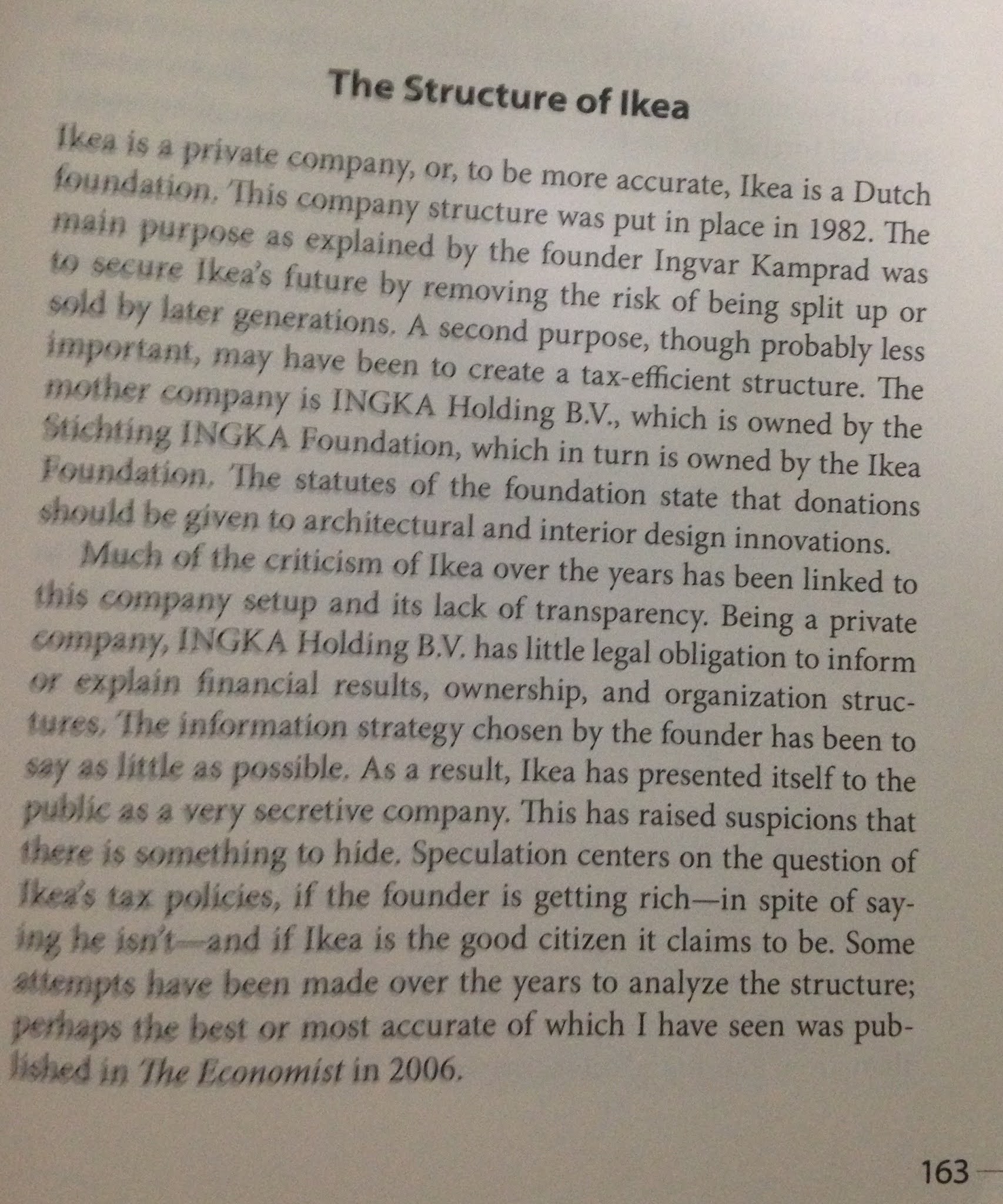
For many who love IKEA and work at IKEA adoring its environmental efforts or collaboration with UNICEF, there is always the dark side that is not as commonly known - that is IKEA's parent company is a non profit and there are questions about how much tax it is paying or duly paying.

Started with this Economist Article: https://www.economist.com/business/2006/05/11/flat-pack-accounting, and finally made it into Singapore online articles here this year: https://blog.seedly.sg/ikea-singapore-charity/

 Here is how Anders Dahlvig explains it:


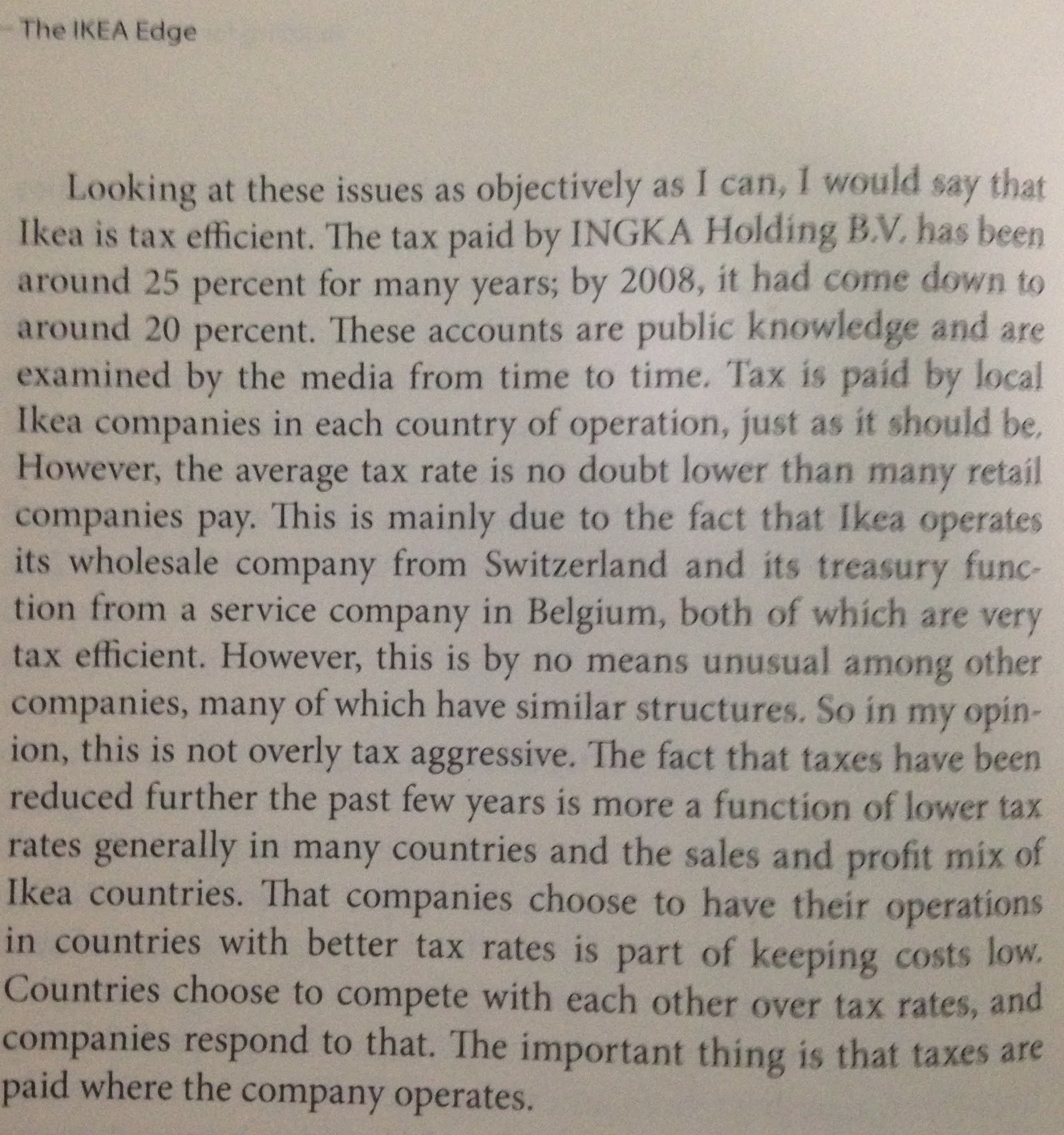
Perhaps as Anders put it: 

  • Such practices may once be perfectly acceptable decades ago but maybe less so now. 
  • More importantly, all these that IKEA has done is perfectly LEGAL. 
  • Perhaps, what is acceptable now is to be more transparent with it.  I do think coming to 10 years after the publish of this book, IKEA is becoming more transparent with its taxes. ..

This reminds me about the ongoing 2020 Singapore Parliament Debates about Foreign Talents.    As Pritam Singh says, sometime we just need more data to have a meaningful discussion.  Of course, compare the glowing admiration given to IKEA as compared to adoration given to individuals like Warren Buffett who openly asked to be taxed more, or Patagonia who willing pays a 1% tax for the Planet.

 When I first joined IKEA, the top environmental effort told to me by Shikin was that our wooden products have no formaldehyde - it is apparently catalyzed by Japan.

When I was at IKEA, there is always this remark that "We are doing many good things, we are not communicating about it enough!"   And that's the issue as Anders put it below:

  • Communication with Customers is the hardest because getting their attention is hard enough.  For these specific environmental issues, only employees and stakeholders with special interests will be interested.

It is true too that:

  • IKEA usually only talks about things they have done and if we do talk about things in the future - it is always something with a target that we are confident of reaching.
  • When external stakeholders see the employees of the company act in accordance with the values they profess, they are more confident that the company means what it says and that environmental commitments are just some vague big lines of words.  Among the limited companies I have worked for, IKEA is for me the company that lives it values most voraciously in the everyday life.


Last but not least, it's true - people coming form outside of IKEA has trouble working there especially if they enter as management.  They will not understand why you need to work on the floor, help on busy days etc...

 
How does IKEA continue to keep its prices down:

IKEA focused on growing its customer base even if it meant in the short run, sacrificing its profit margins...


Sunday, September 06, 2020

The Truth about IKEA

It is pretty cool that among all the stores in the world - Johan's book chose IKEA Alexandra as the cover.  Available since 2010, I may read it since 2014-2015, some of the the things do ring true.


We took a LONG time to go online and maybe it is because it is as it is, we want people to go through the store and be lured to pick up many more things..

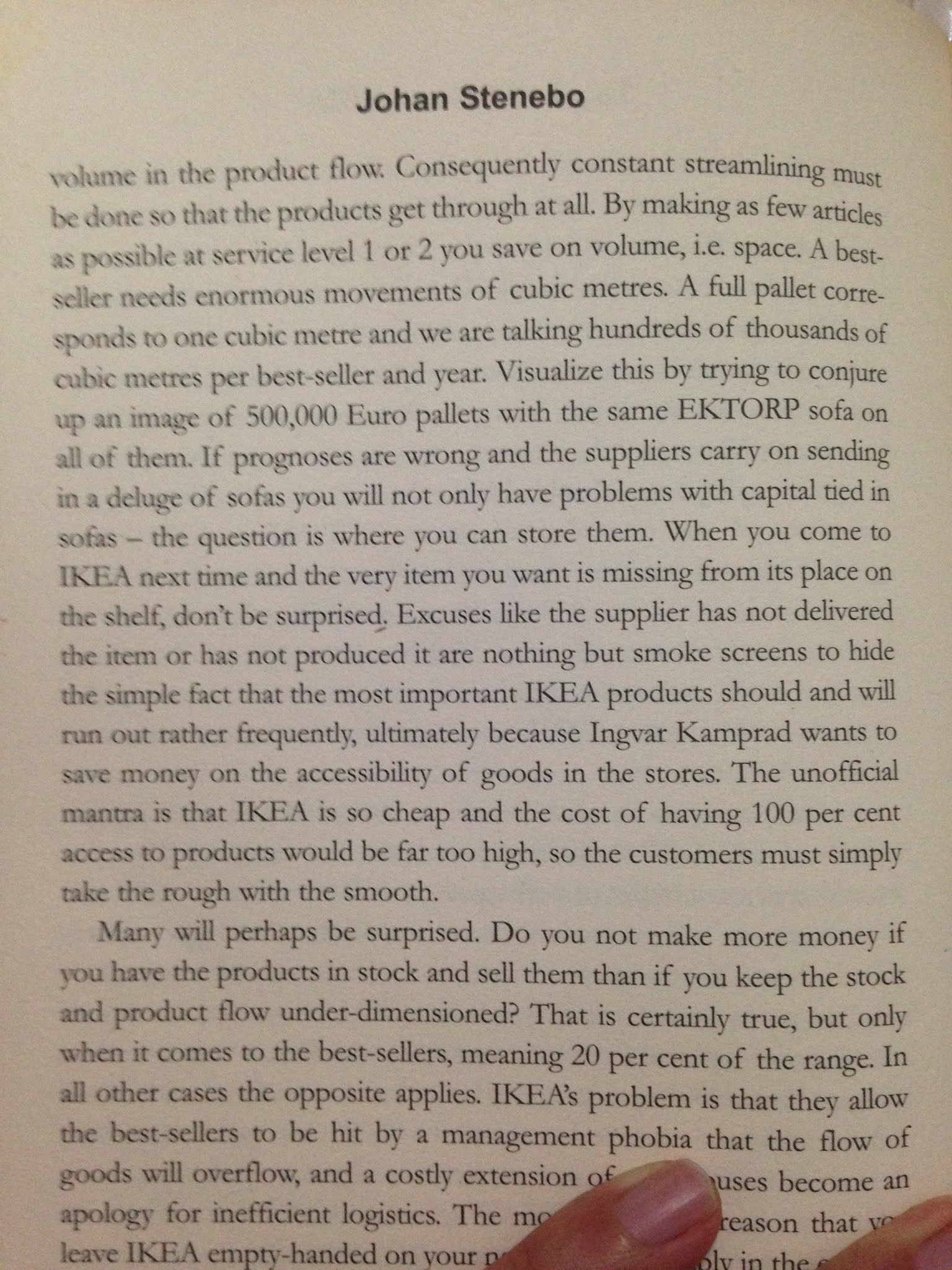
All the Sales Supply Support people will find the following very familiar , always trying their best to keep Service Level 1 Products up.

The following probably illustrates even better how IKEA is as much a Logistic business as it is a retail business.  How can we keep all Service Level 1-3 products always available in the store with limited space?  With the priority given to Service Level 1 products rightfully, there may hard to stock the Service Level 3 products.

Yet at the same time, there is a desire to ship the products directly from Supplier to store, but the turnover rate of the products in the store in weeks while a entire container will be enough for months...


Yet, there is the curse of instant gratification which applies to both an egg cup and leather sofa.  Johan suggests maybe that Instant Gratification should not apply to bigger products like kitchen and sofa - to free up another 30% of store warehouse space.
 
 
Hence, it seems the following principles are  contradictory but true at different levels:
- Instant Gratification  hence all things must be in stock according to IKEA mantra.
- Yet, we are told  that Service Level 2,3 products move slowly and hence may not need to be in stock
- Best to ship Supplier to Floor, which by its turnover rate may be suitable only for Service Level 1 products. 

Johan seems to suggest:
- For even service level 1 products best sellers like certain sofas, there should not be instant gratification because many customers want it to be delivered anyway.
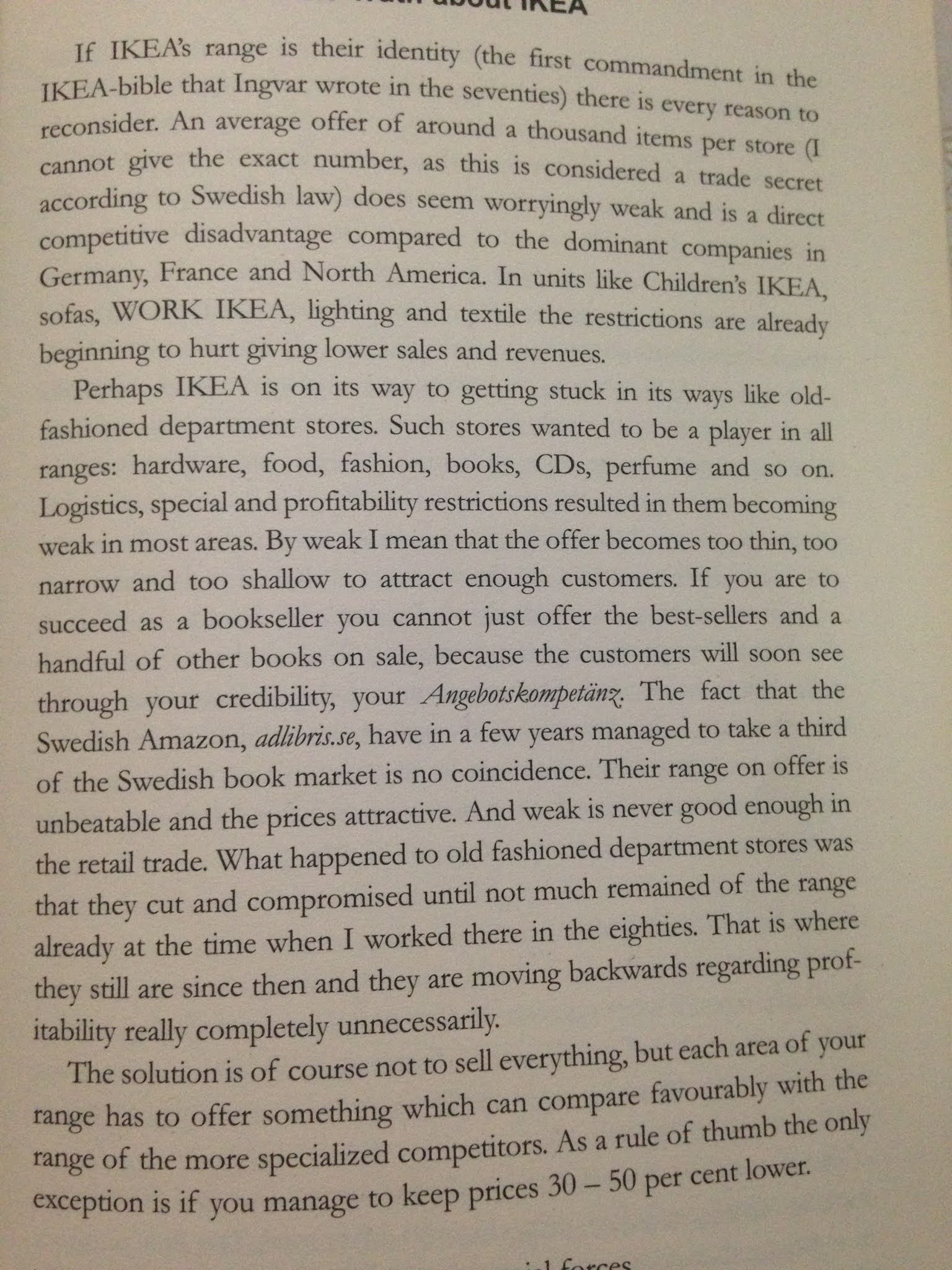
- Probably can free up warehouse space for a) Service Level 2-3 products, b) more supplier to floor shipping and c) a depth of products in each segment as stated below why it is to be important.


And finally to the dark secrets of IKEA we all have an issue with, if we bother to learn more:


Add caption


There are 2 parts of it: One is the complicated structure of IKEA that allows it to pay little taxes - one could argue that all MNC does that to some extent. 

The other part of it is how IKEA coworkers are sold the idea that they are "creating a better everyday life for the many people", on a social mission, to fatten the wallets of a man/family who is pretending to be poor.  If you search, you will be able to find Ingvar Kramprad in suits when he first started out IKEA before the later look of an old man wearing a flannel shirt for years.. 

 Still, this maybe too like the ongoing debate with Workers Party and the government. Why do you need so much money for? Spend it on the people.  I must say through all these means, IKEA has been able to open store after store - with no need to raise money through the stock market or having any other investors...

That says a lot, but the question to ask while it really works to grow the brand, what good does it do for the coworkers, customers and the planet if IKEA keeps growing? 


No dancing girls on top

You Live only Once